| REVISION TABLE Version | Date of review | Overview | Reviewed by | Signed off by |
| 1.0 | 11/12/2024 | New Document | John Hazelhurst | Christopher Gatheridge |
| 2.0 | 15/07/2025 | Updated due to Company Logo – July 2025 | John Hazlehurst | Christopher Gatheridge |
| 3.0 | 19/12/2025 | Annual review | Andrew Murphy | Chris Gatheridge |
Explore Transport is committed to achieving Net Zero emissions by 2050.
Baseline emissions are a record of the greenhouse gases that have been produced in the past and were produced prior to the introduction of any strategies to reduce emissions. Baseline emissions are the reference point against which emissions reduction can be measured.
| Baseline Year: 2023 |
| Additional Details relating to the Baseline Emissions calculations. Methodology |
| Methodology The updated 2019 HM Government Environmental Reporting Guidelines, GHG Reporting Protocol – Corporate Standard have been followed and the 2023 UK Government’s Conversion Factors for Company Reporting have been used. Intensity Ratio The chosen intensity measurement ratio is total gross emissions in metric tonnes CO2e per delivery made. Significant Changes (vs prior year) This financial year has been steady across all divisions, with our main CO2e generating activities (Scope 1 Transport) remaining largely consistent, albeit with a slight improvement. Scope 1 (Heating) emissions have risen due in part to the prolonged cold winter and the need for more heating for our operations. Hydrotreated Vegetable Oil (HVO) still plays a key role in reducing our plant hire fleet emissions as we have seen a wider demographic of hirers also looking to adopt equipment running on HVO. This year has seen us invest over £1million in alternative fuelled plant and equipment. Energy Efficiency Action Our mentor support programme has gone from strength to strength, being recognised with a Motor Transport Award as well as shortlisted for the Chartered Institute of Logistics & Transport (CILT) People development award, this now uses our industry leading telematics overlaid on top of the mentors training to keep safe and fuel-efficient driving in focus. The next financial year will see us introduce our first BEV HGV to the fleet as well as committing to 30 Hydrogen Fuel Cell Electric Vehicles (FCEV). We are working in partnership with the OEMs to develop the product with the aim to reduce our Scope1 emissions by around 35% We have assessed our sustainability strategy & processes against EcoVardis’ global standards and are happy to report we have achieved Silver status (85th percentile) demonstrating advanced management systems. |
| EMISSIONS | TOTAL (tCO2e) |
| Scope 1 | 11,561 |
| Scope 2 | 121 |
| Scope 3 (Included Sources) | 67 |
| Total Emissions | 11,749 |
| EMISSIONS | TOTAL (tCO2e) |
| Scope 1 | 10,941 |
| Scope 2 | 122 |
| Scope 3 (Included Sources) | 55 |
| Total Emissions | 11,118 |
| EMISSIONS | TOTAL (tCO2e) |
| Scope 1 | 9,541 |
| Scope 2 & 3 | 2,320 |
| Total Emissions | 11,861 |
In order to continue our progress to achieving Net Zero, we have adopted the following carbon reduction targets.
| Term | Years | Target |
| Short-Term | 2024-2027 | Reduce total emissions by 15% |
| Medium-Term | 2027-2030 | Achieve a 30% reduction in emissions |
| Long-Term | 2030-2040 | Target a 50% reduction in line with industry benchmarks and potential Net Zero goals by 2050 |
Objective: Implement specific actions to meet reduction targets
| Category | Initiative | Action | Target |
| Fleet Optimisation | Fleet Upgrade | Replace older vehicles with electric or hybrid models | 30% of fleet appropriate fleet to be electric by 2027 |
| Fleet Optimisation | Driver Training | Launch an eco-driving program to reduce fuel consumption | 10% reduction in fuel use within the first year |
| Fleet Optimisation | Alternative Fuels | Pilot the use of biofuels and hydrogen for heavy-duty vehicles | 20% of heavy-duty fleet using alternative fuels by 2028 |
| Energy Efficiency in Facilities | Renewable Energy Adoption | Install solar panels at main depots and offices | 50% of energy needs met by renewables by 2027 |
| Energy Efficiency in Facilities | Energy Management Systems | Implement energy monitoring systems across all sites | 10% reduction in energy use by 2025 |
| Supply Chain and Procurement | Sustainable Procurement | Prioritise suppliers with low-carbon footprints | 50% of key suppliers to be certified sustainable by 2026 |
| Supply Chain and Procurement | Collaborative Partnerships | Work with partners to optimise logistics and reduce overall emissions | Reduce Scope 3 emissions by 15% by 2028 |
| Waste Management | Circular Economy Practices | Implement waste reduction, reuse, and recycling initiatives | 75% of waste diverted from landfill by 2027 |
| Waste Management | Waste-to-Energy Initiatives | Explore waste-to-energy projects to reduce landfill dependence | Convert 30% of waste to energy by 2030 |
Progress against these targets can be seen in the graph below:
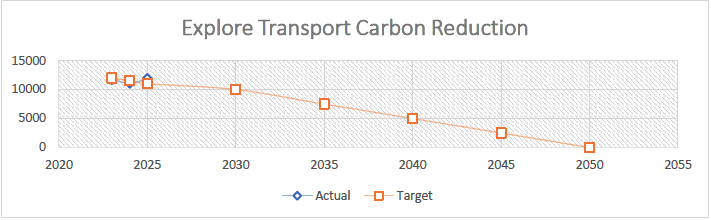
The following environmental management measures and projects have been completed or implemented since the 2023 baseline. 2025 results when recorded where increased on 2024 and target but these are mainly due to a change in project work vs crane ballest profile and a delay on an electric 4×2 tractor that would deliver into central London.
Explore Transport has fitted trackers on their fleet of road going assets as well as their civils and On Track Plant (OTP) machines which enables Explore Transport to monitor idling. Explore Transport also implements a regime of routine inspections and audits which monitors the business activities and highlights any idling engines. Spefically in regard to new OTP, Explore Transport has a procedure to pre-upgrade programme on all OTP which results in a more efficient and less polluting engine performance.
Explore Transport has a policy to ensure all new purchased assets meet or exceed Euro 6 for roading going vehicles and EU Stage IV regulations for plant to reduce NOx emissions and for better fuel consumption. These engines have sophisticated exhaust after-treatment components and reduced combustion temperatures which radically reduce emissions.
Explore Transport Hire Ltd has a robust Road/Rail vehicle maintenance policy which has a framework to provide preventive maintenance and scheduled tune-ups for engines to operate efficiently. The maintenance plan has been developed in line with best practice standards and the Explore Professional Head of Engineering is responsible of its implementation.
Encouraging video conferencing and use of public transport. Using communications technology rather than making a journey by road is the most effective way of cutting business mileage and therefore emissions which will help deliver our strategy.
Explore Transport is also certified for ISO14001 and has a yearly audit with an external certified company to keep our company at the forefront of environmental standards.
At Explore Transport, we are committed to reducing our carbon footprint and implementing sustainable solutions across our operations. We understand that sustainable practices are essential not only for reducing emissions but also for long-term operational efficiency. Below is an outline of the future measures we plan to implement to meet our carbon reduction goals:
The most significant factor in reducing fuel consumption is the person behind the wheel. Well-trained drivers can anticipate road conditions better, reduce idling, and maintain momentum more efficiently. It is estimated that fleets could achieve up to a 10% improvement in fuel economy through dedicated driver training programmes.
Explore Transport is planning to implement a robust driver training system to promote fuel-efficient driving. This programme will focus on key energy-management techniques under the operator’s control, such as optimising start/stop practices, adhering to maintenance schedules, and refining the use of cursie control including ‘plantooning’. The ultimate aim is to reduce fuel consumption, lower operating costs, and minimise harmful vehicle emissions.
We are also committed to exploring alternative fuel options for our construction equipment. Hybrid, Battery-electric and hydrogen fuel cell / combustion technologies present significant opportunities for reducing emissions across our fleet of civil plant and OTP machinery.
One promising option is the adoption of hybrid excavators. These machines utilise a swing system with integrated electric motors, capturing energy during deceleration and using it to assist acceleration. This process helps reduce fuel consumption by approximately 15% compared to traditional models. Such solutions will enable us to offer greener alternatives to our clients while improving the sustainability of our fleet.
Battery-powered equipment offers zero-emission operations and is particularly suited to smaller, lighter machinery with predictable work patterns. For larger equipment and operations requiring extended use, hydrogen-powered machinery provides a promising alternative, offering quick refuelling times and extended operational range without the need for long charging periods.
By introducing both battery-electric and hydrogen-powered construction equipment, we can offer our clients environmentally friendly options that align with the broader industry shift towards sustainable construction practices.
As part of our long-term strategy to decarbonise our heavy goods vehicle (HGV) fleet, we are evaluating the introduction of hydrogen-powered trucks. These vehicles, powered by hydrogen fuel cells, produce zero emissions at the point of use, making them a critical component in our journey towards net zero. By integrating hydrogen HGVs, we aim to significantly reduce our reliance on diesel and support the wider adoption of hydrogen as a sustainable energy source within the logistics sector.
In addition to exploring electrification and hydrogen, Explore Transport is growing it current offering of fleet powered by HVO as part of our carbon reduction strategy. HVO is a renewable and sustainable alternative to conventional diesel, made from waste fats and oils. It offers a significant reduction in greenhouse gas emissions—up to 90% compared to standard diesel.
The benefits of HVO are particularly advantageous as it can be used in existing diesel engines without modification, allowing for a smooth transition without the need for new infrastructure or vehicles. HVO also burns more cleanly than traditional diesel, resulting in lower particulate emissions and nitrogen oxides, contributing to better local air quality. By integrating HVO across more of our operations, we will not only reduce our carbon footprint further but also enhance the sustainability of our wider fleet while continuing to deliver on operational efficiency.
To further reduce fuel consumption, we will install photovoltaic solar panels on all On-Track Plant trailers. The energy captured from sunlight will be converted into electricity and stored in generator batteries, reducing the need for diesel-powered generation. This will be a key initiative to reduce the environmental impact of our plant operations.
We will engage with trade bodies and local communities to raise awareness of promote sustainable initiatives such as:
We will engage with the Energy Saving Trust to conduct a Green Fleet Review, a service funded by the Department of Transport. This review should help identify additional cost-effective actions that can reduce transport emissions, lower running costs, and improve our overall environmental performance. In addition to calculating the carbon footprint of our fleet, the review will focus on several key areas, including:
Recent data from the Energy Saving Trust suggests that implementing the recommendations from a Green Fleet Review can result in savings of up to £1,000 per vehicle annually. For Explore Transport, with a fleet of 200 vehicles, this could translate into potential savings of £200,000 each year.
This strategy highlights Explore Transport’s proactive approach to sustainability, combining immediate actions like driver training and HVO fuel with long-term investments in battery-electric and hydrogen technologies. Together, these initiatives will drive us towards our goal of achieving significant carbon reductions and enhancing environmental performance across all our operations.
This Carbon Reduction Plan has been completed in accordance with PPN 06/21 and associated guidance and reporting standard for Carbon Reduction Plans.
Emissions have been reported and recorded in accordance with the published reporting standard for Carbon Reduction Plans and the GHG Reporting Protocol corporate standard1 and uses the appropriate Government emission conversion factors for greenhouse gas company reporting2.
Scope 1 and Scope 2 emissions have been reported in accordance with SECR requirements, and the required subset of Scope 3 emissions have been reported in accordance with the published reporting standard for Carbon Reduction Plans and the Corporate Value Chain (Scope 3) Standard3.
This Carbon Reduction Plan has been reviewed and signed off by the board of directors.
Chris Gatheridge

Operations Director, Explore Transport Limited

 info@explorepts.com
 03453 100 500


